

An all-time favourite, this meal is typical of the Ewes of Ghana but is widely eaten in Ghana. It is usually eaten with akple or banku, a starchy fermented dough cooked into a thick paste. Many other cultures across West Africa have okro-based dishes as part of their staple.
You can make okro soup with or without palm oil, without any oil at all, with chicken, goat meat or an assortment of fish and meat. Okro soup can also be eaten with kenkey, gari or even rice. A friend from Mali introduced me to rice and okro but have never had the guts to try it for reasons that are quite silly, to be honest.

For the first time okro soup eaters, the slime could be off-putting but in my experience, everyone I've met and who has tasted this for the first time has absolutely loved the dish. Another okro soup recipe with no palm oil however is this tasty goat meat okro soup.
Other fantastic authentic Ghanaian recipes are Agbeli Kaklo, Waakye with stew, Gari Foto, and Groundnut Soup.
Ingredients
The main ingredients for this soup are the okro and the palm oil. The okro can either be used in its fresh form or frozen. See tips on how to store okro in the freezer.
A great way to check whether your okros are fresh is to snap the tips. You should not use old okros for this as they are almost impossible to cut up or grate and your soup will not get that characteristic slime that it is known for.

Momoni, a salted fish (see photo below) adds a lot of flavour and therefore it is best to fry it in the heated palm oil before you add all other ingredients to tinge the oil. Momoni has a potent smell and flavour and therefore should be used sparingly.

Instructions
The first step is to fry the momoni in the hot palm oil and then fry the onions in it. Add the tomates and the shrimp powder. Afterwards add the crab some salt and shrimp, and fish


Once you let that simmer for a while, you can then add the either the chopped/grated okro or the thawed okro from the freezer.
When adding the fresh okro to the tomato base, you can either add the grated okro directly into the base or you can cook it for about a minute separately. Over medium heat and with a few tablespoons of water, beat or whisk the okro to tease out the slime and then add to the base stew.
I use both methods interchangeably depending on how I am feeling. In this recipe I use frozen, slightly cooked okro.


The resulting okro soup is a beautiful spicy mix of clams, crabs, mackerel and shrimp in a palm oil base. And oh, you eat this with your fingers because it's the best way to eat this. Save the cutlery for another meal.
Substitutions
- Fish Sauce - fish sauce makes a great substitute for momoni as it has a similar pungent smell and taste.
- Vegetable Oil - you can easily substitute the palm oil with vegetable oil and the soup will be just as tasty.

Okro Soup Tips
- If you have a large batch of okro and you need to store them for later use, grate them, add a bit of water and then cook for about 2 minutes. Once cool, portion them and store in the freezer.
- There are a number of factors that can reduce the sliminess of the okro soup. One of them is using too many tomatoes. Another factor is covering the soup pot with compeletly with a lid completely while the soup is still hot.
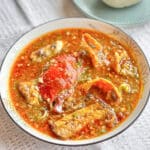
Okro Soup
Ingredients
- 3 tablespoons palm oil
- momoni optional
- 1 medium onion chopped or blended
- 1 medium tomato blended
- habaneros, kpakposhito (green Pettie belles)or red Pettie belles blended
- 2 tablespoons smoked shrimp powder
- 3 small dried herrings with bones removed
- 4 medium crabs cleaned
- ½ medium smoked mackerel divided into smaller chunks
- handful clams without shell and cleaned
- shrimp fresh or dried, peeled and deveined
- 6 medium fingers okro grated or chopped
Instructions
- Heat the palm oil and fry the momoni making sure to break it down into smaller bits in the oil as you fry it. This should take about a minute.
- Add onions and fry them for about 2 minutes.
- Add blended tomatoes, scotch bonnets or kpakposhito and shrimp powder and cook for about 2 minutes.
- Add crabs and then dried herring, and then the clams. Add enough water to just about cover the ingredients and allow to simmer for another 10 minutes.
- In a separate pan, add 2 tablespoons of water to the grated okro and cook for about 1 min. This is mainly to tease out the slime without having to overcook it in the stew base. See notes 2.
- Add the fresh shrimp and mackerel to the stew. Avoid over stirring especially if the smoked mackerel is not firm.
- Add okro from the other pan to the soup and mix through, letting it cook for a further 3 min. Turn off heat but do not cover soup completely with the lid.
- Turn off the heat but do not cover the soup completely with the lid.
- Serve with banku or kenkey or Gari
Video
Notes
- If you are using fresh shrimp then add them when you are just about to add the okro so that they do not overcook. If you are using dried shrimp, however, then add that after you add the tomatoes as they can be a bit tough. You can also soak them in hot water before using them.
- If you are using frozen okro that has already been precooked, you can ignore this step.
Jerri says
Howdy, i read your blog occasionally and i own a similar one and i was just curious if you get a lot of
spam responses? If so how do you prevent it, any plugin or anything you can recommend?
I get so much lately it's driving me crazy so any assistance is
very much appreciated.
Edinam says
Hey there, yes I get a lot of spam - it is actually quite annoying. But I manually approve every comment so I just delete the ones that come through. I am sure there is a plugin to prevent them coming in, in the first place but I have no idea what that plug in is.